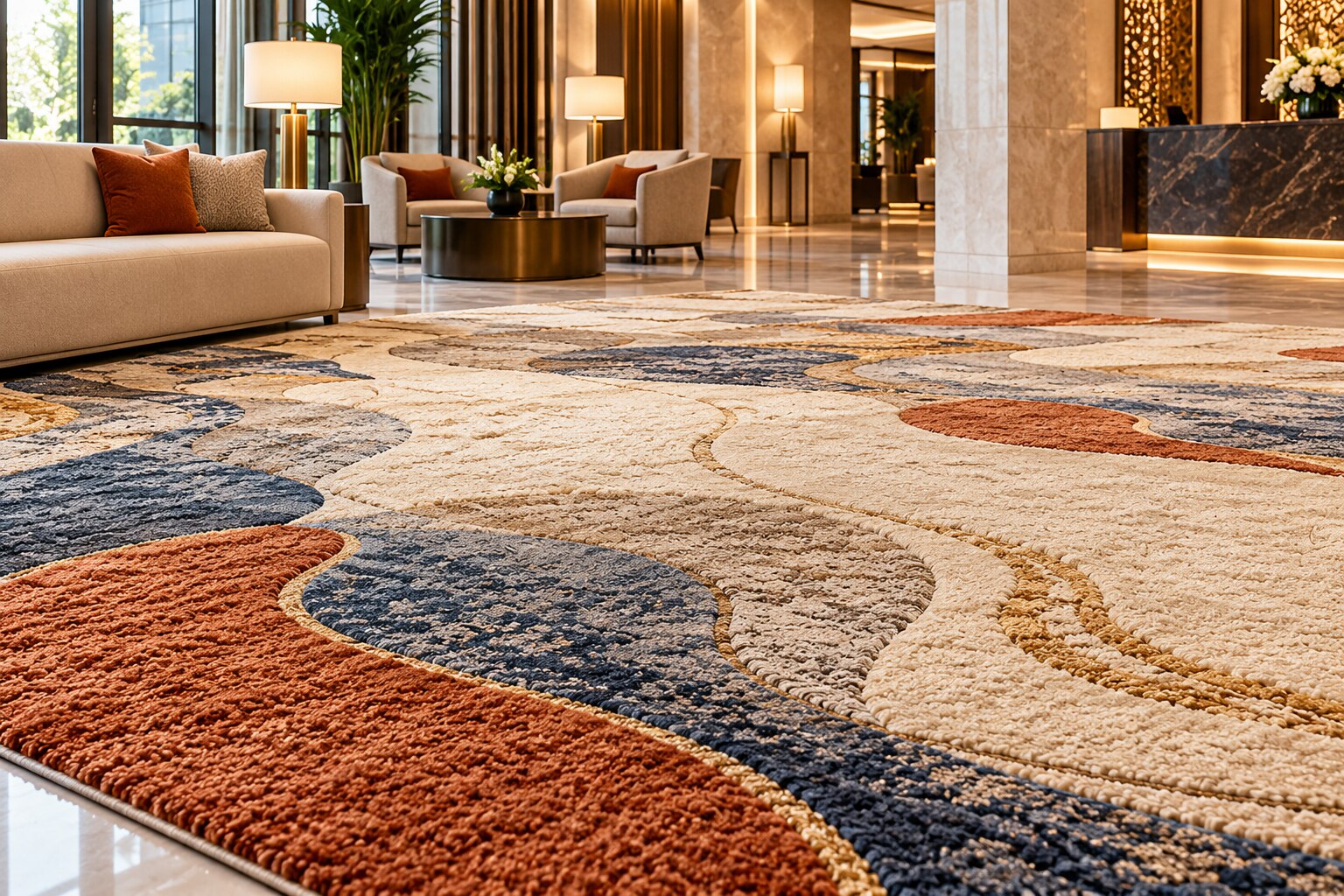
Hotels must balance a distinctive interior with heavy footfall, cleaning demands, fire requirements and the cost of future repairs. By comparing construction, flooring zones, pile specifications and procurement risks, you can decide where hand tufted carpet earns its place and where tiles, broadloom or hard flooring is the better choice.
Key takeaways
- Match carpet construction to traffic, moisture and cleaning access.
- Specify pile height, density, fibre, backing and seam requirements in writing.
- Request samples, colour approvals, test reports and a replacement plan.
- Choose textures that conceal marks without complicating vacuuming or stain removal.
Why hand tufting fits a hotel design brief
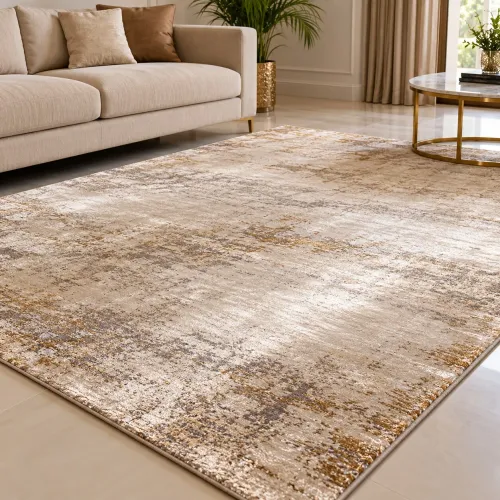
A hotel design brief often needs a carpet that is visually exact without commissioning a fully woven construction. Hand tufted carpet inserts yarn into a primary backing with a tufting gun, then secures it with adhesive and usually adds a secondary backing.
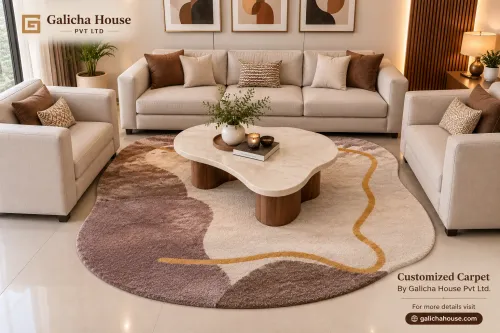
This process supports custom colours, borders, motifs, pile heights and room-specific shapes in manageable production quantities.
| Format | What it offers | Where it differs |
|---|---|---|
| Hand tufted carpet | Bespoke pattern, colour, texture and border with straightforward design revisions | More design control than standard broadloom, without the complexity of woven production |
| Machine-made broadloom | Continuous rolls, consistent repeat and efficient coverage | Suits large uniform areas but limits unusual motifs, custom borders and small bespoke runs |
| Woven carpet | Dense integrated construction and refined pattern detail | Strong design character, but production is slower and custom changes can demand more planning |
| Carpet tiles | Modular replacement and access to the floor below | Practical for offices, yet visible seams and module limits can weaken a luxury hotel scheme |
| Loose rugs | Flexible placement and easy removal | Define zones attractively but shift, curl or create trip edges unless secured |
That balance makes hand tufted carpet useful in guest rooms, suites, lounges, restaurants and meeting spaces where the floor must coordinate with upholstery, wall finishes and lighting.
A hand tufted carpet Ghitorni dealer can also coordinate approval, measurement, production follow-up and installation queries; put tolerances, inspection points and responsibility for site defects in the purchase order. It still needs a written cleaning plan, because bespoke appearance does not make a tall or sculpted pile low-maintenance.
How construction and hotel location determine suitability
A hotel hand tufted carpet works best where design control matters more than rapid section replacement.
Yarn is inserted into a primary backing with a tufting gun, secured with adhesive, and finished with a secondary backing; that construction supports custom borders, motifs and pile heights, but it also makes adhesive cure, backing stability and edge finishing critical.
| Area | Suitable construction | Use another format when |
|---|---|---|
| Guest rooms and suites | Dense low or medium cut pile; furniture stays mostly stationary | Hard flooring suits luggage wheels, spills or frequent room-turnover cleaning |
| Lounges, executive areas and restaurants | Dense cut, loop or mixed-texture pile with protected transitions | Chairs scrape continuously or food and drink spills demand faster recovery |
| Meeting and banquet spaces | Low, dense pile with stable backing and firmly finished edges | Tables, staging and heavy trolleys create repeated concentrated loads |
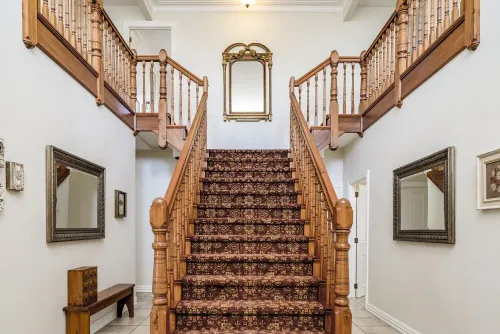
| Corridors and lift lobbies | Tightly constructed low-cut or loop pile, supported by documented appearance-retention testing | Tall sculpted pile would crush, track or show traffic lanes |
| Entrances, kitchens, spas and pool surrounds | Carpet only in dry transition zones, with slip-resistant detailing | Water, grease, grit or disinfectants are routine; use porcelain, resilient flooring, rubber or stone |
The same hotel hand tufted carpet should not run through every zone. Corridors and banquet routes need stronger wear evidence than guestrooms, while a tall loose pile can lose its pattern quickly under wheels and repeated vacuuming.
Approve a physical sample before production. Check pile direction, shedding, adhesive odour, dimensional stability and joint behaviour, then confirm daily vacuuming, spot treatment, periodic extraction and a method for replacing damaged sections.
The specification that predicts wear, cleaning and replacement
Specify construction by traffic zone, not by hotel-wide appearance. Dense low-cut pile or tightly built loop resists crushing, wheel tracking and repeated vacuuming; tall, loose sculpting wears visibly sooner and complicates extraction cleaning.
| Zone | Pile and yarn | Density and backing | Edge and replacement detail |
|---|---|---|---|
| Guest rooms and suites | Medium-height cut pile; wool-rich or wool-nylon yarn for comfort | Moderate-to-high tuft density; stable secondary backing with fully cured adhesive | Bound perimeter; retain the approved dye lot, pile height and yarn specification |
| Corridors, lifts and reception routes | Low-cut pile or tight loop; hard-wearing nylon blend | Highest practical tuft density and yarn weight; dimensionally stable backing to prevent ripples | Reinforced, tightly bound edges; record seam positions and direction of pile |
| Lounges and executive areas | Dense low-to-medium cut pile or controlled tip-shear | High density where chairs move; firm backing that resists delamination | Cleanly serged or bound perimeter; keep a replacement piece from the production run |
| Ballrooms and banquet spaces | Low, dense cut pile or tight loop that tolerates chair movement and extraction | Specify stitch rate, tuft density and adhesive cure; avoid loose sculpted construction | Reinforced seams and transitions; document modular repair sections |
A custom hand tufted carpet in Delhi should be approved from a physical strike-off, not a screen image. Check dye-lot colour, pile direction, shedding, backing odour, adhesive cure, dimensional stability and edge finish before bulk production.
Write the approved pile, yarn, density, backing and edge details into the purchase record, then attach a written vacuuming, spot-treatment and periodic-cleaning plan. Without that record, a later replacement can match the drawing but not the installed carpet.
How fibres and surface textures change daily performance
Wool, nylon, polypropylene, viscose and blends behave differently under vacuuming, spills, wheeled traffic and repeated footfall; the surface texture can amplify those differences.
| Fibre | Daily performance | Best comparison point |
|---|---|---|
| Wool | Resilient, comfortable and good at hiding minor soil; moisture and slow drying demand disciplined spill response. | Pair with dense loop or low cut pile in guest areas and lounges. |
| Nylon | Strong recovery from compression and suitable for busy routes; assess stain resistance and the specified treatment. | Compare dense low-cut pile with loop pile for corridors and lift lobbies. |
| Polypropylene | Resists many water-based stains and absorbs little moisture; lower resilience can leave crush marks. | Use a compact construction, not a tall sculpted surface, where traffic is constant. |
| Viscose | Adds sheen and a soft, luxurious hand; water, abrasion and aggressive cleaning can produce visible damage. | Reserve for decorative, lower-traffic zones and protect it from spills. |
| Blends | Combine properties, but the ratio determines the result; a small viscose content still affects cleaning risk. | Demand the exact fibre percentages and test the finished blend, not just loose yarn. |
Loop pile usually hides tracking and tolerates repeated vacuuming. Cut pile feels softer but shows compression sooner; tip-sheared pile adds tonal depth, while carved and mixed-texture designs create visual interest at the cost of more difficult spot cleaning and uneven wear.
Approve a physical strike-off. Record yarn, colour, pile height, texture and pile direction, then retain the production sample for future matching. For corridors and banquet routes, request appearance-retention evidence such as ASTM D5252 testing; it indicates simulated wear, not a guaranteed hotel lifespan.
What to demand from a Ghitorni dealer before placing the order
Ask a hand tufted carpet dealer for a production sample, not a showroom swatch. Compare colour under hotel lighting, pile height, tuft density, backing stability, seam appearance and edge finish. Keep the approved sample with the purchase order.
For carpet dealers in Ghitorni, hand tufted carpet proposals are easier to compare when every quote uses the same scope:
| Compare | Demand in writing | Reject or question if |
|---|---|---|
| Sample checks | Adhesive-cure condition, backing odour, shedding, dimensional stability and a 600 mm sample edge | The sample smells strongly, ripples, sheds heavily or has an unfinished edge |
| Tests and inspection | Results from agreed checks, plus inspection before dispatch and after installation | “Premium quality” replaces measurable acceptance criteria |
| Installed cost | Carpet, pattern development, sampling, wastage, joins, site cutting, curved edges, freight and fitting | The price covers only square metres |
| Replacement support | Dye recipe, construction details, batch records, spare material and a method for matching damaged sections | No promise exists for future colour or pile matching |
Write tolerances for dimensions, colour variation, seams, edge curling and backing adhesion into the order. State who pays when a site measurement is wrong, a joint opens or installation damages the floor.
GALICHA HOUSE PVT LTD 8384046294 can be evaluated on the same evidence: ask for the approved sample, room-by-room quantity schedule, care plan and replacement procedure before comparing its quote with another dealer.
Related products
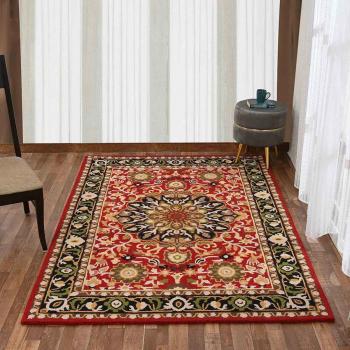 | Tufted Woollen Carpet Tufted Woollen Carpet Tufted Woollen Carpets by Galicha House Pvt. Ltd. Bring warmth, elegance, and timeless beauty into your interiors with Tufted Woollen Carpets from... |
 | Hotel Carpet Hotel Carpet Hotel Carpets by Galicha House Pvt. Ltd. Enhance the elegance, comfort, and sophistication of your hospitality spaces with premium Hotel Carpets from... |
Frequently asked questions
Why does hand tufting fit a hotel design brief?
Hand tufting allows custom colours, patterns, shapes and pile effects without commissioning a fully woven carpet.
How do construction and hotel location determine suitability?
Match the construction and backing to the room’s traffic, moisture exposure, trolley use, cleaning routine and installation conditions.
Which specifications predict wear, cleaning and replacement?
Check pile height, pile density, yarn type, backing system, adhesive, seam method, colourfastness and warranty terms.
What should you demand from a Ghitorni carpet dealer?
Request a full construction sheet, physical sample, colour approval, maintenance instructions, lead time, installation scope and replacement availability.
Related products
 | Wall to Wall Hand Tufted Carpets Wall to Wall Hand Tufted Carpets by Galicha House Pvt. Ltd. Redefine luxury and comfort with Wall to Wall Hand Tufted Carpets by Galicha House Pvt. |
 | New Zealand Wool Hand Tufted Carpet New Zealand Wool Hand Tufted Carpet New Zealand Wool Hand Tufted Carpets by Galicha House Pvt. Ltd. |
Keywords